



































































The Science of Smell
Take a deep breath. Whether you are smelling fresh cookies or a putrid skunk, you are actually pulling microscopic pieces of the physical world directly inside your head. Let us explore how our incredible olfactory system converts chemical shapes into vibrant, long lasting memories.
The Invisible Connection
Everything tastes nearly identical! While your tongue detects basic sensations like sweet or salty, the intricate flavour of foods comes almost entirely from your sense of smell. Without olfaction, flavour simply vanishes.
They use specialised hairs! Moths possess microscopic, highly sensitive hairs on their antennae. These hairs can filter and identify specific chemical molecules floating through the air across massive distances.
Put Your Instincts to the Test
Think about what you already know about how we detect scents. Pick an answer for each question, then see if your instincts were right.
No, you cannot! Your tongue only identifies basic traits like sweet or salty. The nuance of flavour is processed by your olfactory system detecting volatile food molecules travelling up the back of your throat.
Your sensory receptors become fatigued! This is called olfactory fatigue. Your cells become saturated by the constant signal and temporarily stop firing intense electrical pulses to your brain to prevent sensory overload.
To act as a safety warning system! Because natural gas is invisible and odourless, humans would never know if a pipe was leaking. The added odourant triggers our nose immediately, saving us from potential danger.
Understanding the Science
Tap each card to reveal the explanation.
Key Concepts
Volatile Molecule
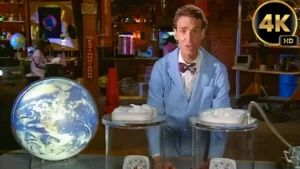
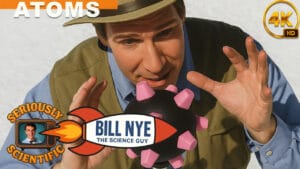
Tap to learn moreA volatile molecule is a tiny, microscopic chemical particle that easily evaporates into the air. These floating structures have distinct geometric shapes that physically lock into our biological receptors. Bill Nye the Science Guy demonstrates that when you smell burning toast, actual pieces of that toast are entering your body. Without these physical particles, there would be nothing for our noses to detect.
Olfaction
Tap to learn moreThis is the formal biological process and terminology for the sense of smell. It involves capturing airborne chemicals, translating their physical structures into electrical impulses, and interpreting those signals. Our brains use olfaction to help us find food, avoid danger, and navigate our environment. It is one of our most ancient and vital sensory systems.
Olfactory Epithelium
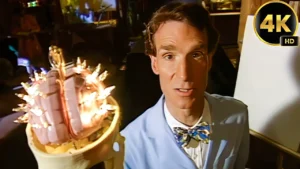
Tap to learn moreThis is a specialized tissue layer lining the absolute top interior of the human nasal cavity. It serves as the primary landing pad where floating odour molecules are captured and processed. Bill Nye the Science Guy uses models to show how this patch of tissue is packed tightly with specialized nerve cells waiting for the right chemical to arrive.
Nasal Mucus
Tap to learn moreThe slippery water based goop inside the nasal passage plays a critical role in how we smell. Odour molecules must physically dissolve within this liquid layer before they can reach the nerve structures underneath. If your nose is too dry or completely blocked with excess mucus from a cold, the molecules cannot reach their target.
Receptor Cell
Tap to learn moreThese are highly specialised sensory neurons that function exactly like a biological lock. They only trigger an electrical signal when a molecule with a matching shape slots perfectly into them. Bill Nye the Science Guy demonstrates this lock and key mechanism to explain why we can distinguish between the smell of a rose and the smell of a skunk.
Olfactory Bulb
Tap to learn moreThis structural brain region is located just above the nasal cavity. It acts as the grand central station for smell, collecting incoming nerve data and instantly organising chemical patterns into recognisable scent profiles. From here, signals travel directly to the parts of the brain responsible for memory and emotion.
Pheromones
Tap to learn moreA specific chemical signal released by an animal to communicate with others of the same species. These invisible scent trails allow creatures, like ants or bees, to broadcast messages about danger, identity, or food locations to their colony. Animals use these powerful odours to organise their entire societies without ever making a sound.
Olfactory Fatigue
Tap to learn moreThis is a protective sensory adaptation where receptors become temporarily desensitised after prolonged exposure to a scent. It prevents the brain from being overwhelmed by a single background smell. This is why you stop noticing the smell of your own house or a strong perfume after wearing it for a few minutes.
Try It: The Molecular Catcher
The olfactory epithelium contains millions of static receptor cells. In this fast paced lab, you control five of them! Use the Molecular Key on the left panel to understand which chemical shape creates which smell.
Your Goal: You have 30 seconds to complete the current level. Click the biological locks on the right to change their shape. Catch 5 of the same molecules to successfully register that smell. You must register all three target profiles to win the round!
Apply Your Knowledge
Let us see if you can correctly identify the highly specialised vocabulary used by sensory biologists.
Match the Concepts
Click an object to select it, then click the matching description to place it.
Real-World Challenge
Imagine you are a food scientist designing a new line of fruit gummies. You want to rigorously demonstrate how the human brain combines multiple senses to create the perception of flavour. Design a step by step experiment using blindfolds, nose clips, and varying fruit solutions to isolate the exact role of the tongue versus the nose. Define your independent, dependent, and controlled variables. How will you gather repeatable data from your test subjects to support your conclusions?
What Has Changed Since This Episode Aired
This episode first aired in 1998. While the core science remains accurate, here are a few things that modern research has expanded upon.
Updated: Modern olfactory research from 2014 demonstrated that the human nose is far more discerning than previously thought. By testing human sensitivity to complex molecular mixtures, scientists now understand we can distinguish at least 1 trillion unique olfactory stimuli.
Updated: While retronasal olfaction provides the structural nuance of flavour, contemporary neurobiology reveals flavour is actually a complex, multisensory ecosystem. The brain dynamically synthesises chemical inputs from tongue taste receptors with tactile texture data, temperature, visual colour cues, and even auditory sounds to construct the total flavour experience.
Updated: Scientists and engineers have successfully developed electronic noses powered by artificial intelligence. These digital sensor arrays mimic the human olfactory system and can quickly detect the chemical signatures of diseases like cancer, demonstrating impressive diagnostic accuracy.
Test Your Understanding
Answer these questions and get instant feedback. How many can you get right?
Results
Your score:
Reflection
Consider a specific, powerful scent that immediately reminds you of an old holiday, a past home, or a childhood memory. Based on what you have learned today regarding the olfactory bulb and the human nervous system, explain why smells are able to trigger intense, emotional memories much faster and more vividly than sights or sounds.
Episode Discussion
Share your thoughts on this Bill Nye The Science Guy episode