






























Pseudoscience
Extraordinary claims require extraordinary proof! From mind-reading and alien encounters to magic tricks and astrology, the world is full of wild claims. But how do we separate genuine science from pseudoscience? It all comes down to testing.
Can You Bend a Spoon With Your Mind?
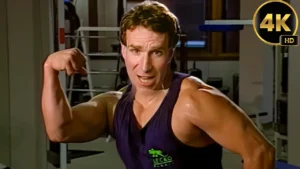
It is not magic, it is physics! Their physical weight is distributed evenly across hundreds of nails. Because there are so many nails packed closely together, no single nail has enough concentrated pressure to pierce the skin.
It would look like a random, scattered group of stars. Constellations only look like specific shapes because of our exact viewing angle from Earth. In reality, those stars are trillions of miles apart in deep space.
Test Your Scientific Instincts
We see extraordinary claims every day. Pick an answer below to test your knowledge.
They looked at the Moon! During a lunar eclipse, the Earth casts a shadow on the Moon. The only shape that always casts a perfectly round shadow from any angle is a sphere.
It is untestable! If a claim cannot be measured, tested, or proven wrong through repeated experimentation, it falls under the category of pseudoscience rather than actual science.
The Science of Critical Thinking
We have a golden rule in science: Extraordinary claims require extraordinary proof! Tap the cards below to reveal the keywords of critical thinking.
Key Concepts
Science
Tap to learn moreThe rigorous process of understanding the natural world by testing claims with repeatable experiments and physical, observable evidence.
Pseudoscience
Tap to learn moreA claim or belief that sounds highly scientific but cannot actually be tested, proven, or repeated, such as mind-reading or astrology.
Extraordinary Proof
Tap to learn moreThe scientific standard that if someone makes a highly unbelievable claim, they must provide equally strong, undeniable evidence to support it.
Constellation
Tap to learn moreA random grouping of stars that appear to form a picture when viewed from Earth, even though they are actually completely disconnected in deep space.
Force Distribution
Tap to learn moreThe physical principle where weight is spread across many points. It explains why a person can safely lie on a bed of nails without injury.
Optical Illusion
Tap to learn moreA visual trick that deceives the eye and brain, often used by magicians to make physical science seem like real magic.
Testable Claim
Tap to learn moreA statement or hypothesis that can be actively investigated through experiments and physical observation to see if it is true or false.
Static Electricity
Tap to learn moreThe buildup of an electrical charge (electrons) on the surface of an object, which can jump as a visible spark to a conductor.
Interactive: The Pseudoscience Master Lab
Select an experiment tab below to test three common "extraordinary claims" using the scientific method!
The Testing Challenge
Let us see if you can correctly identify the essential terminology associated with critical thinking and scientific inquiry.
Match the Concepts
Click a scientific term to select it, then click the matching description to place it.
Design a Fair Test
Imagine your friend claims they have developed "psychic powers" and can correctly guess if a coin will land on heads or tails every time it is flipped. Using the rules of science, how would you design a strict, repeatable experiment to test their extraordinary claim and prove if it is science or pseudoscience?
Pseudoscience in the Digital Age
This episode originally aired in 1996. While the core scientific method has not changed, the ways we encounter pseudoscience have evolved dramatically!
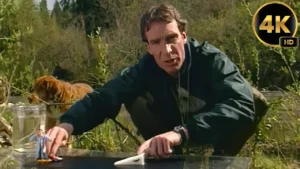
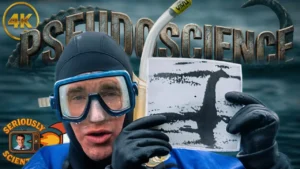
Updated: In the 1990s, Bill Nye the Science Guy explained that the famous Loch Ness Monster photo was faked using simple clay and a toy submarine. Today, AI-powered "Deepfake" technology can create highly realistic fake images and videos in seconds. This makes it more important than ever to carefully analyse digital media and ensure things are truly legitimate before accepting them as proof!
Updated: The episode explains that giant telescopes had not seen alien spacecraft, but Bill Nye mentions the high probability of life given the billions of galaxies. Today, missions like the James Webb Space Telescope have discovered thousands of "exoplanets" orbiting distant stars, giving scientists real, testable, and scientific locations to search for biological signatures.
Updated: Bill Nye explains why astrology is a pseudoscience because its claims are vague and untestable. While smartphone apps have made astrological horoscopes more popular than ever for entertainment, modern astronomy has continued to map dark matter, black holes, and the accelerating expansion of the universe using purely empirical data.
Test Your Understanding
Answer these 10 questions and get instant feedback. How many can you get right?
Results
Your score:
Reflection
Have you ever seen a video on the internet that looked completely real but turned out to be a hoax or a visual trick? How can you use the scientific rule of "extraordinary proof" to evaluate the videos you see online today?
Episode Discussion
Share your thoughts on this Bill Nye The Science Guy episode